Friday

Marianne, Chip and the Hackamore

This is a photo of Marianne and her former racehorse named Chip. Marianne and Chip live in Austin, Texas.  Chip is wearing a hackamore, which is a bridle without a bit. 

A hackamore works by putting pressure on specific parts of a horses head. Different types are placed either higher or lower depending on the severity of the pressure. 

A bosal has a continuous rawhide noseband and because it is gentle on the horse, it is frequently used for training young horses in western style riding.


The hackamore Chip is wearing is called a mechanical hackamore because it encircles his entire face and has long shanks on the bottom with a curb chain. The chain underneath must be set at least loose enough to get two fingers between the chain and his chin. Mechanical hackamores are used for pleasure and trail riding only, they are not allowed in competitions because if not used properly they can hurt the horse. An experienced rider like Marianne knows how gentle she must be to use this type of bridle.


Endurance riders like hackamores because they allow the horse to eat and drink easily while working. They are also good for horses with sensitive mouths, and you will find them being used in all sorts of equestrian sports from barrel racing to eventing, trail riding to stadium jumping.


* Do you know what Chip's coat color is called?

Thursday

Jackie and Rembert and the Large Pony Hunters

What judge could resist the expression on this pony's face? This is 12 year old Jackie and her pony, Trigger (show name Rembert). Jackie and Rembert show all over the eastern states in the Regular Large Pony Hunters.


Pony hunter classes are separated first by the size of the pony. A "small" is any pony who measures 12.2 hands and under. A "medium" is a pony between 12.3 and 13.2 hands. A "large" pony is 13.3 to 14.2 hands. 


A judge would have a difficult time finding fault with Jackie and Trigger going over this fence. The pony is eager, his expression is exactly what a rider hopes for, his legs tucked neatly, and he is already looking toward the next fence. He and Jackie clearly trust each other.


Jackie is immaculately turned out in appropriate hunter show ring attire, and the expression on her face shows she is concentrating on the rest of her course while having fun. Many hours every day go into training, conditioning and preparing for the level of shows Jackie and Trigger compete in. No wonder they come home with so many blue ribbons!


* Do you know what a "hand" is when measuring a horse or pony, and where the measurement is taken?

Wednesday

Chrissy and Flip ~ Retraining Thoroughbreds for Eventing

This is Chrissy, with her off the track Thoroughbred (OTTB), named Flip. Thoroughbreds who don't make it as a racehorse can be retrained for many, many other uses. A second career as an event horse is a popular choice for many thoroughbreds, and this is why Chrissy took on Flip for a retraining project.


Chrissy  specifically picked Flip because of his athletic build and correct confirmation, so she wouldn't have to battle confirmation flaws while retraining him. Chrissy also liked his outgoing personality and "can do" attitude, which has helped him overcome some of the scarier parts of event horse training. His rider will be pleased with that later in his career when they are faced with unusual obstacles.


About 75% of the work Chrissy does with Flip is flat work, which is helping him learn to stretch through his back and neck. Flip loves to jump, but until his body can become more flexible through the important work they do on the flat, he is at the limit if his abilities over fences. To keep him fresh and having fun, Chrissy shows him in jumper shows where he gets practice for the stadium part of eventing later on. 


* Do you know the order in which the three tests in a three day event are ridden, and why?

Tuesday

Rainmaker and the Summer Camp Ranch

Never has there been a horse-girl or boy who didn't dream of spending a summer at a pony camp, where all day, everyday, kids work with the horses and play with the ponies; get their hands soapy with coconut scented horse shampoo; ride along the trails under a canopy of trees, perhaps even down for a swim in a creek to cool off on especially hot days; learn about feeding, grooming, tacking; everything to send them on their way to becoming expert horse people.

This is a picture of Rainmaker, who is a favorite at Circle R Ranch in Long Prairie, MN. Circle R is an overnight camp where kids stay at the ranch for an entire week, or more. The camp days center around the horses and ponies, but there are other activities like swimming, a dance, and a horse show.

Day camps for horse-girls and boys are just as popular. An example would be the day camp at Columbia Horse Center in Laurel, Maryland, which runs in two week sessions. Besides the two riding lessons everyday the camp assures the kids learn while having fun with costume day, watermelon eating contests (where the kids vote on the horse/pony who eats the most watermelon), mock horse shows, trail rides, horse and pony crafts, and a graduation ceremony that includes a drill team performance by the kids.

Circle R Ranch is in need of in kind donations of supplies to keep their camp going strong. Anything from lead ropes to saddle pads, pony books to halters are appreciated.

You can find information about summer horse camps through your local horse association, or for these two farms in particular, their web sites are: www.circelrranch.com or  www.columbiahorsecenter.com.

* Do you know what the two ropes with clips at the end that hang from the walls in a barn aisle are called? They are used to hold the horses steady when they are being groomed.

Thursday

Rebel and the Working Student

This is Rebel, a school horse at Reddemeade Equestrian Center in Maryland. Standing with Rebel is Nina, who is part of Reddemeade's Working Student Program.


Working Student Programs help riders earn more lessons and ride time while teaching them all aspects of running a busy stable. Typically a stable will have a minimum age requirement for a student to become part of the program. This is for safety reasons.


On a typical day a Working Student might groom and tack horses and ponies for lessons, help students get their mount to the ring, clean stalls, wash buckets, polish tack, feed, turn horses out, and hold horses for the vet or farrier. 


More advanced Working Students get to school (ride and refresh the training) new horses, and are often responsible for working a horse through a particular issue which may be keeping him or her out of the lesson program. This is done under the supervision of professional trainers. Many working students end up as professional riders and trainers, or go to college and study equine business management.


* Do you know the difference between a flea bitten gray or a dapple gray horse?

Wednesday

Lyric and the Swedish Oxer

Lyric is being ridden by a professional rider, Javier, over a Swedish oxer in a jumper class. The  poles on a Swedish oxer are slanted in opposite directions, so they appear to form an "x" when the horse is approaching the fence. 


All oxers include two vertical fences next to each other, which make for a wider jump, or a spread. Oxers are used in both hunter and jumper courses, but a Swedish oxer would only be used in a jumper course.


Horses who are used for jumper courses are bold, athletic, brave and careful. Tight turns, awkward approaches to unusual fences, and controlled speed are all part of riding a successful jumper course.  The winner is the horse/rider combination with the cleanest round (meaning no knock downs or run outs) and the fastest time.


* Do you know what horse and rider team jumped the highest jump on record at 8' 1.25"?

Tuesday

Brie and Katie ~ Champion and Reserve Champion Friends

Brie just won a Championship on Domino, who she calls Smarty Pants. Her friend, Katie, won the Reserve Championship on Noelle. Brie's Championship ribbon has blue, red and yellow streamers on the front. Katie's Reserve Champion ribbon is red, yellow and white. 


Prize ribbons have a different color for each place in the class. 
* 1st Place is blue
* 2nd Place is red
* 3rd Place is yellow
* 4th Place is white
* 5th Place is pink
* 6th Place is green
The best thing about this photo is that it shows how friendships are made with ponies. 
* Do you know what the riding boots are called children this age are expected to use?

Monday

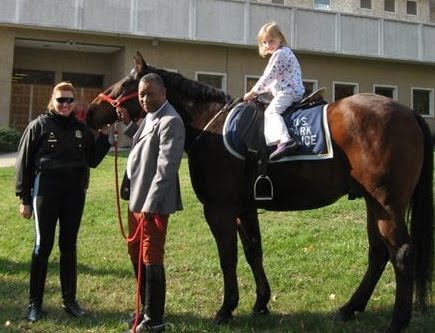
Jack the United States Park Police Horse

You'll be surprised to learn some of the different roles a Park Police horse plays in the lives of the people within his/her community. 


This is a photo of Jack, an eleven year old Quarter Horse who is a special member of the US Park Police. With Jack are his law enforcement partner, Officer Barbara Blendy, Retired USPP Ofc. James "Bullet" Watson, and Sarah who is being treated to her first ride on a horse, courtesy of the Park Police.


Jack has visited Walter Reed Army Medical Center and given rides to recuperating warriors and their family members. Park Police horses are also used in the Ride Well Program where veterans with brain injuries do hands on work with horses during their rehabilitation. 


Park Police horses must be steady, obedient, quick and intelligent, plus they must be what is referred to as "bomb-proof." They are often used for crowd control at large events, during protests or riots. Experts say one horse in a crowd is as valuable as fifteen or twenty foot patrol officers. A Park police horse and his/her partner must trust and respect each other, which creates a special bond between horse and human.


To learn more about the history and activities of the USPP horses, click here:  http://www.nps.gov/uspp/fhorsepage.htm

* Do you know why Jack's breed is named Quarter Horse?

Sunday

Jane and the Hanoverian

Wahiro is a 13 year old Hanoverian who was imported from Germany by his owner, Jane. Wahiro competes in Fourth Level Dressage and in this photo he is demonstrating an uphill canter.


Dressage tests start with USDF Introductory Tests which are performed at the walk and trot only. The progression of more advanced tests are:
* Training Level Tests 1 - 4 in which the horse and rider show themselves at the walk, trot, working canter, free rein, circles and halts.
* First Level Tests 1- 4 which add lengthening strides, canter loops, stretching down at the trot, and leg yielding.
* Second Level Tests 1-4 which add movements such as the collected trot, renvers, half turn on the haunches, and serpentines at the canter with simple lead changes.
* Third Level Tests 1-3 which add movements such as flying changes and counter canter.
* Fourth Level Tests which add movements such as collected canter, half pass, shoulder in, half-pirouette, three flying lead changes and an extended canter.  

After Fourth Level comes Prix St. George, Intermediaire I and II, followed by the most difficult test, Grand Prix which adds movements such as Piaffe and Passage. 

The origins of dressage movements are quite surprising. Check back another day for a fascinating trip into Greek history and the cavalryman Xenophone.

* Do you know what a test is called when it is performed to music?

Saturday

Katie's Riding Helmet at Paradise Stables

Katie is getting a ride on a paint pony at Paradise Stables. Katie is wearing a regulation USEF safety helmet. Anyone who wants to start taking riding lessons does not need a full outfit of proper riding apparel before their first lesson, but an approved safety helmet is mandatory. It is not recommended to buy a used helmet as sometimes cracks may have happened that you cannot see.


Also very important are hard soled shoes, or boots, with a small heel. The heel is important to keep the riders foot from slipping through the stirrup irons, and it also will help keep the heel pointed down and the toes pointed up. This is not only for safety, but this is also to ensure the rider learns how to balance correctly.

Mike Smith, who owns several large equestrian schools in Maryland and is a published author on the topic of riding lessons, says the only other requirement is a sense of humor!

* What is the long, thin piece of leather called that the stirrup iron is attached to?

Friday

Alex and Silver at the Pony Races

Alex and Silver are taking part in the Pony Races at Shawan Downs in Maryland. Pony Races are run on the same day as regular, large horse steeplechaes, also called point-to-points. The term "point-to-point" comes from how the races originated in England. Riders would challenge each other to races through villages, over hill and dale, the starting point being a church in one town, and the finish line at a church in another town. The "point" refers to the top of the church steeple, which was often the only "map" a rider would have. 

The Pony Races are open to amateur riders, under the age of 16, on ponies. All ponies must be a minimum of 5 years old. Riders follow the Field Master over a flagged course which is about 2 miles of fair hunting country (meaning the land and obstacles are similar to what the rider might encounter on a fox hunt). After the last fence, the Field Master will release the field to race for the finish line. Riders are encouraged to wear racing silks to represent their stable colors. The races are separated into small, medium and large ponies.

* Do you know why some steeple chases are called "timber races?"

Thursday

Rio Rides a Hunter Course on Best Kept Secret

Rio is riding her large pony hunter, Best Kept Secret, over a course of jumps at a hunter show.You can tell it is a hunter course, and not a jumper course, because the fence is very natural, simulating those  they might encounter on a real fox hunt in the country. If this were a jumper course, the fences would be very gaudy, painted in bold, bright colors with stripes and a variety of different patterns. 

At this fence, the judge will approve of the way the pony's knees are tucked neatly. The keen expression on his face shows he is interested in what he is doing, and is athletic enough to do it. He is taking off exactly where he should, and will land on the other side of the fence nicely.

* Do you know how a pony is measured to determine whether he or she is a small, medium, or large pony hunter? 

Wednesday

Chip and the Case of the Floating Teeth

Chip is a former racehorse who is owned by Marianne in Austin, TX. Just like humans, horses have a dentist take care of their teeth. In this photo Chip is having his teeth "floated."  The equine dentist has put a brace in to hold Chip's mouth open (see the silver bar around the edge of his mouth?) so he can use the rasp to smooth the sharp edges.

A horse's digestive system is not as well developed as many mammals, and their body cannot process food efficiently if it is not chewed up into minuscule pieces.  If Chip's teeth were allowed to continue to grow without being floated, the sharp edges would hurt and he wouldn't chew as well as he should, causing him to lose weight.

Horses in the wild don't get their teeth floated, but they eat in a way that is more natural for them. The take a bite or two of grass, walk a few steps, take another bite or two and walk a few more steps. They eat almost all the time they are awake and the constant grinding keep their teeth from needing work. 

If you look closely on the wall above Chip's head you can see a photo of one of his foals.  


Do you know how many teeth an adult horse has?

Tuesday

Little Katie the Companion Pony

Talk about an extraordinary friendship! Nick is a 17 hand Hanoverian who was confined to his stall for many months after shoulder surgery. When Nick became depressed and stopped eating, Little Katie was brought in to live in the stall with him as a companion. 

Little Katie is a registered Shetland pony. It is her job to help people and other horses feel better. She has made many trips to hospitals and nursing homes, to cancer centers and schools for kids with special needs. She also sometimes lives with other horses who needed a companion to make them feel better.

You might think Little Katie would be intimidated by a giant like Nick, but horses have a unique way of communicating. When she was first put in the stall, Little Katie turned her hindquarters to Nick, flipped her tail a few times, and tipped her heels up with a squeal that said, "Stay back, Buster, I'm in charge here!"

Little Katie was successful in helping Nick recover completely.

Do you know what the tallest horse was ever recorded?

Monday

Brigid and Austin and Three Day Eventing

Three day eventing is one of the most challenging equestrian sports. A horse must be brave, athletic, obedient and sound in order to compete in eventing. Horse and rider teams perform three tests during an event: dressage, cross country and stadium jumping.

In this photo you can see Brigid with her horse Austin, about to plunge into the water. Water obstacles are common in eventing. On the cross country course she might jump anything from a stack of brush, to a picnic table or a stone wall. 

Riders who enjoy eventing say galloping over a cross country course is exhilarating and addicting. Event riders spend a lot of time training and preparing their horses for competitions and it takes 100% dedication to be successful.

* Is Austin a piebald or skewbald? Answer through the comments. All people who guess correctly will have their name put in a hat and one winner will be drawn. Winner gets a $15 gift certificate to Anytimetack.com. 

Sunday

Annabel and Bob the Haflinger Pony

This is Annabel, age nine, at her first Junior Young Riders Dressage Show at Morven Park in Virginia.

Her pony, Bob, is a Haflinger. You can tell by his rich chestnut body, highlighted by a flaxen (blond) mane and tail. This color is also sometimes called sorrel. A Haflinger's coat can be anywhere from a pale blond to almost chocolate brown, but the closer to white the mane and tail are, the better.

Haflingers were bred to work on the rocky terrain of the mountains in Austria, so they are naturally sure footed and make great trail horses. You can see Annabel is carrying a whip when she rides Bob. She won't use it on him, but because Haflingers can be every bit as hard headed as they are smart, just holding it in her hands makes Bob a little more energetic in this test.

* What is your favorite breed of pony? Let's vote!